
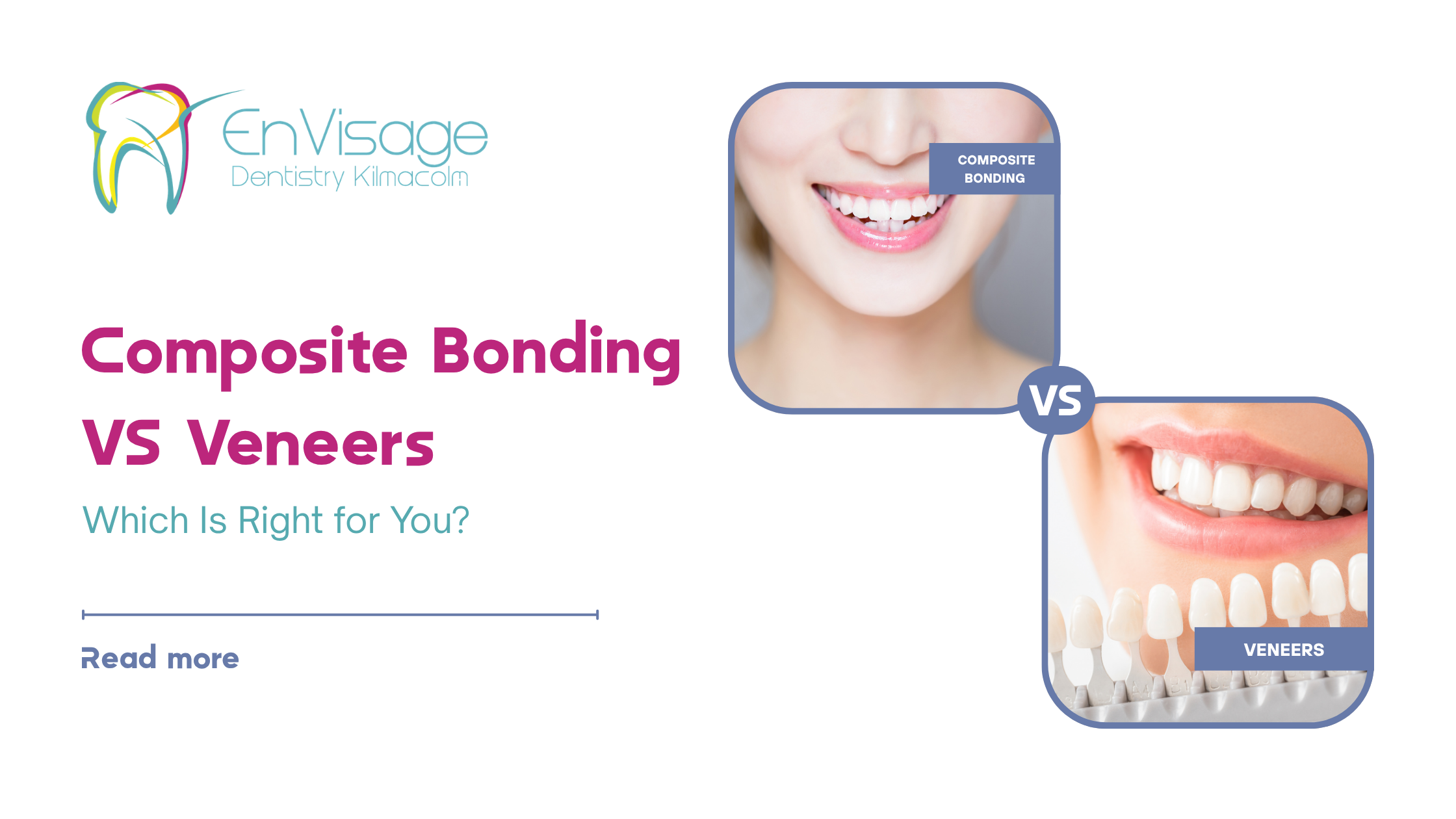
If you’re thinking about improving your smile, you’ve probably come across two of the most popular cosmetic dental treatments: composite bonding and porcelain veneers. While both can improve the appearance of chipped, uneven or discoloured teeth, they work in different ways and suit different situations.
At Envisage Dentistry Kilmacolm, we’ll help you understand your options and recommend the treatment that’s most appropriate for your smile, goals and budget.
What Is Composite Bonding?
Composite bonding uses a tooth-coloured resin that is carefully applied, shaped and polished directly onto your tooth. It can improve the appearance of chipped edges, small gaps, worn teeth and minor imperfections, often in just one appointment.
Because little or no natural tooth structure usually needs to be removed, composite bonding is considered one of the most conservative cosmetic treatments available.
Patients often choose composite bonding because it:
- Repairs small chips
- Closes minor gaps
- Improves tooth shape
- Blends naturally with surrounding teeth
- Can often be completed in a single visit
What Are Porcelain Veneers?
Porcelain veneers are thin ceramic shells that are custom-made to fit over the front surface of your teeth. They’re designed to improve the shape, colour and overall appearance of your smile while providing a durable, stain-resistant finish.
Unlike composite bonding, veneers are made in a dental laboratory, meaning treatment usually takes two appointments.
Veneers are commonly chosen to:
- Improve severely stained teeth
- Correct uneven tooth shapes
- Close small spaces
- Create a more symmetrical smile
- Achieve long-lasting cosmetic improvements
What's the Difference Between Composite Bonding and Veneers?
Although both treatments improve the appearance of teeth, there are some important differences.
| Composite Bonding | Porcelain Veneers |
|---|---|
| Usually completed in one visit | Usually completed over two visits |
| Little or no drilling required | Requires a small amount of enamel preparation |
| Generally more affordable | Higher-cost cosmetic option |
| Easy to repair if damaged | More difficult to repair if damaged |
| May require occasional polishing or maintenance | More resistant to staining |
| Good for small chips, gaps and changes in tooth shape | Highly durable with good care |
| A quicker, more conservative option | A longer-lasting cosmetic solution |
The right option depends on your individual teeth, expectations and long-term goals.
Which Treatment Looks More Natural?
Both treatments are designed to look natural when carefully planned and carried out.
Composite bonding is colour-matched to your natural teeth and blends beautifully with your smile.
Porcelain veneers also provide a highly natural appearance while offering excellent translucency and long-term colour stability. Because porcelain resists staining better than composite resin, veneers tend to maintain their appearance for longer.
Which Option Lasts Longer?
Composite bonding typically lasts several years before it may need refreshing or repairing, depending on factors such as your oral hygiene, diet and whether you grind your teeth.
Porcelain veneers generally last longer and are more resistant to everyday staining and wear, making them a popular option for patients seeking a longer-term cosmetic solution.
Whichever treatment you choose, regular dental examinations and good oral hygiene are essential for maintaining your results.
How Do I Know Which Is Right for Me?
Choosing between composite bonding and veneers depends on several factors, including:
- The condition of your teeth
- The changes you’d like to achieve
- Your budget
- Whether you prefer a minimally invasive treatment
- Your long-term expectations
For smaller cosmetic improvements, composite bonding may be all that’s needed. For more significant smile changes or where longer-lasting aesthetics are desired, porcelain veneers may be the better choice.
During your consultation, your dentist will explain the advantages and limitations of each treatment so you can make an informed decision
Cosmetic Dentistry at Envisage Dentistry Kilmacolm
Our cosmetic dental treatments are tailored to every patient rather than offering a one-size-fits-all solution.
We’ll carefully assess your teeth, listen to your goals and recommend treatment that’s appropriate for your smile. We’ll carefully assess your teeth, discuss your smile goals and recommend the treatment that’s most appropriate for you. While composite bonding is an excellent option for many patients, veneers or another cosmetic treatment may be more suitable depending on your teeth and the result you’re hoping to achieve.
Our aim is always to achieve a natural-looking smile while preserving as much healthy tooth structure as possible.
If you’re considering cosmetic dentistry and aren’t sure which option is right for you, we’d be happy to help.
📞 Call: 01505 873852
📍 Envisage Dentistry Kilmacolm
Frequently Asked Questions
Is composite bonding cheaper than veneers?
Yes. Composite bonding is generally a more affordable cosmetic treatment because it can usually be completed in a single appointment without laboratory work.
Do veneers last longer than composite bonding?
In many cases, yes. Porcelain veneers are more resistant to staining and wear and typically last longer with good care.
Does composite bonding damage your teeth?
Composite bonding usually requires little or no removal of natural tooth structure, making it one of the least invasive cosmetic treatments.
Can chipped teeth be repaired with bonding?
Yes. Composite bonding is commonly used to repair chipped teeth and restore their natural appearance.
Which treatment is best for stained teeth?
It depends on the cause of the staining. Teeth whitening may be suitable for natural teeth, while veneers can improve the appearance of teeth with deeper staining that doesn’t respond to whitening.