
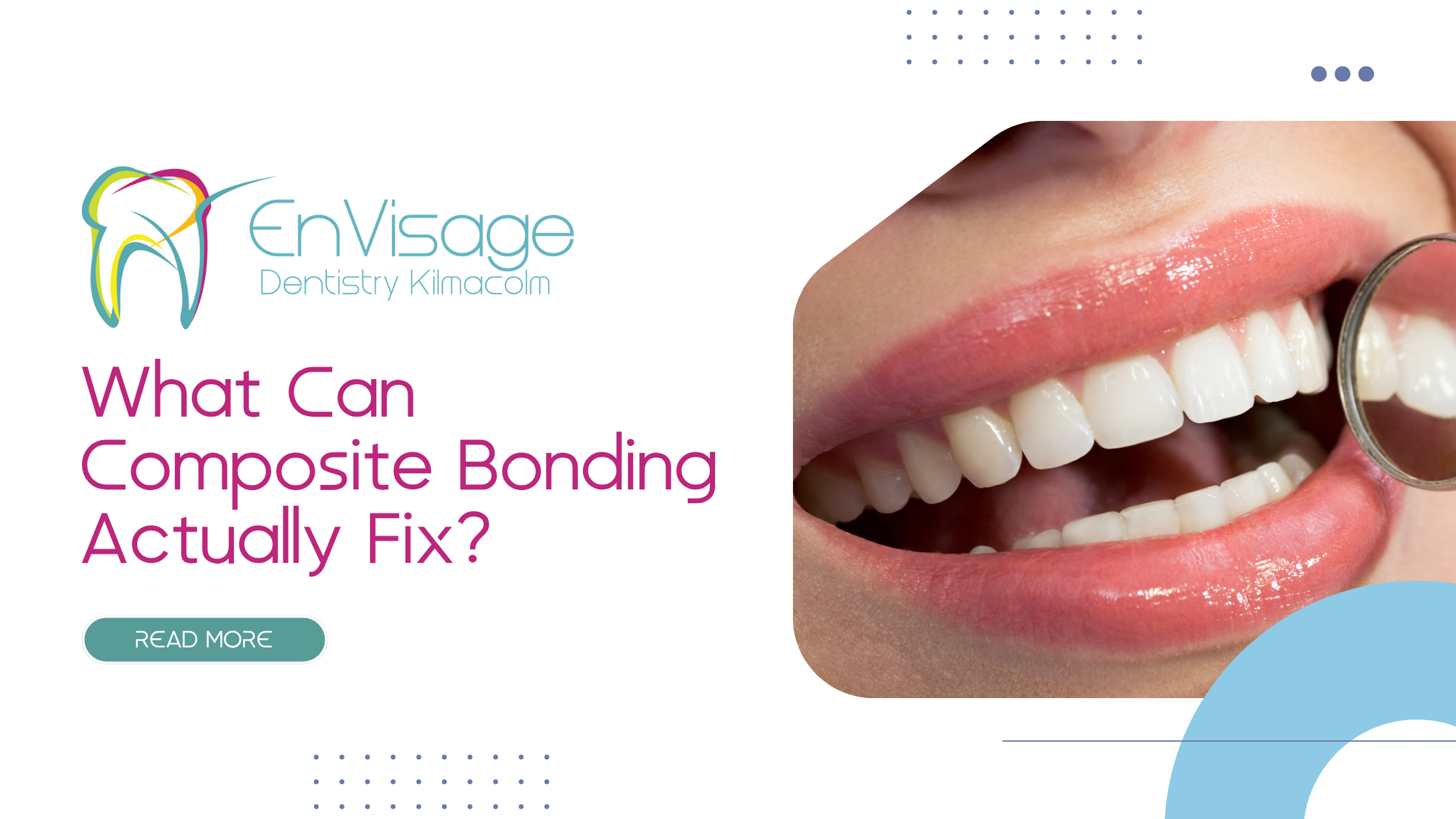
It’s common to notice small things about your teeth that you might like to change. This could be a chipped edge, a slight gap, or uneven shapes that have developed over time. For many patients in Kilmacolm, composite bonding is one of the first options they come across when looking into these concerns.
At the same time, there’s often some uncertainty. You may wonder whether it’s the right solution for your situation, whether the results will look natural, or whether there might be a better approach.
Understanding what composite bonding can realistically achieve and where it may not be the most suitable option can help you make a decision that feels informed and comfortable.
What Is Composite Bonding?
Composite bonding is a technique where a tooth-coloured material is carefully applied and shaped directly onto the surface of a tooth. The aim is to improve the appearance of the tooth in a subtle and controlled way.
The material is matched to your natural tooth colour and sculpted to blend in with surrounding teeth. Once set, it becomes part of the tooth’s outer surface.
Because the process is usually minimally invasive, it often appeals to patients who are looking for small, noticeable improvements without more involved treatment.
What Can Composite Bonding Help With?
Composite bonding is often suitable for addressing minor cosmetic concerns where the underlying tooth is healthy.
It may be used to:
- Repair small chips or worn edges
- Close small gaps between teeth
- Improve uneven or irregular shapes
- Adjust the appearance of slightly misaligned teeth
In these situations, bonding can provide a simple way to refine the overall look of the smile without altering the structure significantly.
Why People Choose Composite Bonding
One of the main reasons patients consider composite bonding is because of its conservative nature. The treatment focuses on enhancing what is already there rather than replacing it.
For many people, this approach feels more comfortable. It allows for gradual changes and avoids more extensive procedures where they may not be necessary.
Bonding is also often discussed when patients are looking for a way to improve appearance without committing to longer treatment plans.
Does This Always Need Treatment?
No and this is an important point to consider.
Small chips, gaps, or irregularities do not always require treatment. In many cases, they are purely cosmetic and do not affect oral health or function.
Some patients choose to leave these features as they are, especially if they are not causing any concern in daily life. A consultation can help clarify whether any change is needed, or whether reassurance is enough.
When Composite Bonding May Not Be the Best Option
While composite bonding can be effective in many situations, it is not suitable for every type of concern.
It may not be the best option when:
- There is significant misalignment of the teeth
- The bite would be affected by adding material
- Teeth are heavily worn or structurally weakened
- A more durable or long-term solution is needed
In these cases, other approaches may provide better long-term stability and function.
Why a Personal Assessment Matters
Every smile is different, and what works well for one person may not be suitable for another. This is why composite bonding is usually considered as part of a broader discussion rather than a standalone solution.
During an assessment, factors such as tooth health, bite, and long-term expectations are considered. This helps ensure that any recommendation supports both appearance and function.
Sometimes bonding is the most appropriate option. In other cases, a different approach may be suggested, or monitoring may be advised instead.
Read our blog on The Power of a Smile Makeover: Combining Cosmetic Braces with Composite Bonding
What to Expect from the Process
Composite bonding is typically carried out in a single visit, depending on the number of teeth involved. The material is applied in layers and shaped carefully to achieve a natural result.
The process is usually comfortable and does not require significant preparation of the tooth. Patients can see the changes as they happen, which can help guide the result.
Afterwards, normal daily activities can usually be resumed without disruption.
How Long Does Composite Bonding Last?
Composite bonding is not permanent, and over time it may require maintenance or replacement.
Its longevity can depend on:
- Daily habits such as diet and oral hygiene
- Bite forces and tooth contact
- General wear over time
With good care, bonding can remain in place for several years, but it is important to understand that it may need review or adjustment in the future.
Thinking Long Term About Your Options
When considering composite bonding, it can be helpful to think about what you would like your smile to look like not just now, but in the future.
Some patients prefer a simple, short-term improvement, while others may want a plan that evolves over time. Understanding this early can help guide whether bonding is the right starting point or part of a wider approach.
Taking a gradual, well-considered route often leads to more comfortable and predictable outcomes.
If You’d Like to Talk It Through in Kilmacolm
If you’re considering composite bonding and would like to understand whether it’s suitable for your teeth, a conversation can help bring clarity.
The team at Envisage Dentistry Kilmacolm can assess your smile, explain what’s possible, and help you decide whether bonding, another option, or simply leaving things as they are would be the most appropriate approach.
📞 01505 873852
📧 [email protected]
FAQs
Does composite bonding damage the natural tooth?
In most cases, bonding is minimally invasive and preserves the natural tooth structure.
Will composite bonding look natural?
When carefully matched and shaped, it is designed to blend in with surrounding teeth.
Can bonding fix crooked teeth?
It can improve the appearance of minor misalignment, but more significant cases may need a different approach.
Is composite bonding permanent?
No. It is a long-lasting but not permanent solution and may need maintenance over time.